


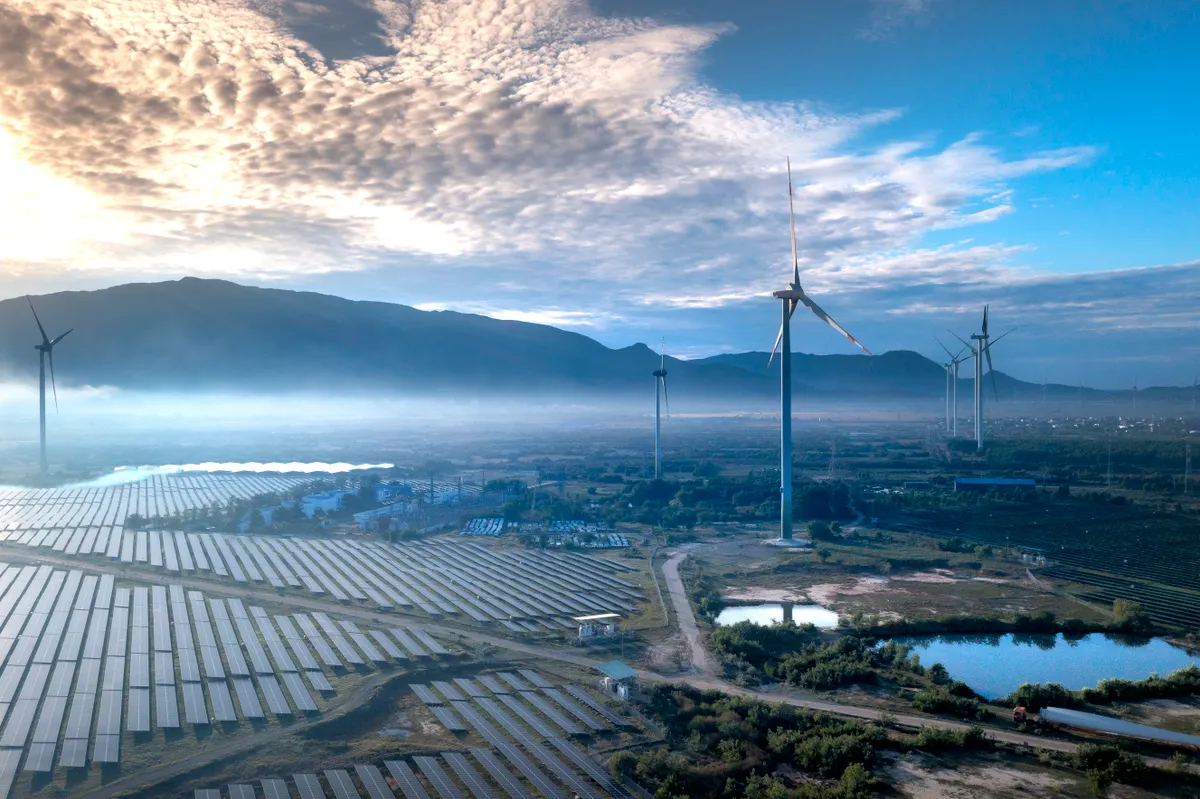
China’s green energy AI push is emerging as the country’s answer to a paradox: decades of breakneck renewable investment have left its grid with more power than the market can absorb. Executives at the Fortune Leaders Forum in Macau laid out how artificial intelligence could turn that surplus into a structural advantage.
Youyuan Huang, executive vice chairman of BTR New Material Group, the world’s leading maker of battery anode materials, put it plainly: “China’s grid is a very strong and stable one. But we’ve installed too much green energy.”
The scale of that installation is vast. China will account for 60% of all installed renewable capacity through 2030, according to the International Energy Agency. In July, solar overtook coal as China’s largest source of installed power capacity.
Daniel Liu, vice president of solar module maker Jinko Solar, said renewables effectively covered all of China’s electricity demand growth last year. The sector has expanded so quickly, however, that energy infrastructure now outpaces what the market needs.
China green energy AI: the case for an intelligent grid
Panellists at the Forum pointed to AI as the tool best suited to manage the mismatch. Data centres and GPU clusters require a large, uninterrupted supply of power, giving China’s renewable surplus a ready customer.
“With the development of GPUs, the power of a single chip has risen dramatically,” Huang said. “This means that if the power drops, data that’s being computed could be lost.”
Physical AI firm Jiangxing Intelligence has built what it describes as an AI “brain” that monitors environmental conditions around renewable infrastructure, forecasting wind and solar output and directing energy storage accordingly. The system also controls a fleet of autonomous robots that inspect and maintain solar panels and wind turbines.
Haitian Pang, founder and chief executive of Jiangxing Intelligence, said the technology addresses one of renewables’ core weaknesses. “The supply of wind and solar energy is highly uncontrollable,” he said. “With an intelligent brain that deeply understands the region’s physical and meteorological conditions, you can forecast wind and solar conditions, and then know what options you need for energy storage.”
Autonomous cleaning drones form part of that system. Dust and debris can reduce solar panel efficiency by up to 30%, and AI-driven machines that move across solar fields to remove deposits are already operating in the field. Pang described how drones can be dispatched automatically when wind and sand bury panels in remote locations. “This way, the entire energy system can run more stably and efficiently,” he said.
Southeast Asia lags as Chinese factories shift south
Elsewhere in Asia the picture is more complicated. The geography of Southeast Asia makes a contiguous electricity grid difficult to build and maintain.
“The Philippines has more than 7,000 islands, while Indonesia has more than 10,000, so it remains to be seen how renewable energy can come into play alongside fossil fuels there,” Liu said.
Huang flagged the tension directly. Many large-scale data centres in Indonesia, where BTR has investments, are still powered by coal, even as Chinese manufacturing relocates to the region.
India, Liu added, has made substantial progress on renewables, though demand for coal remains high.
Despite the patchwork pace of adoption, panellists struck an optimistic note on Asia’s broader energy direction. “The narrative of energy transition differs across countries: for some it’s security, and for others it’s the future,” Liu said. “But they’re all actively embracing renewables.”
Pang said the economics are self-reinforcing: “A clean energy transition, including a lower-cost energy transition, will certainly remain a continuous pursuit for everyone.”
The IEA’s 2030 renewable capacity projections give China’s AI energy sector a firm deadline against which its smart-grid technology will be tested at scale.
