


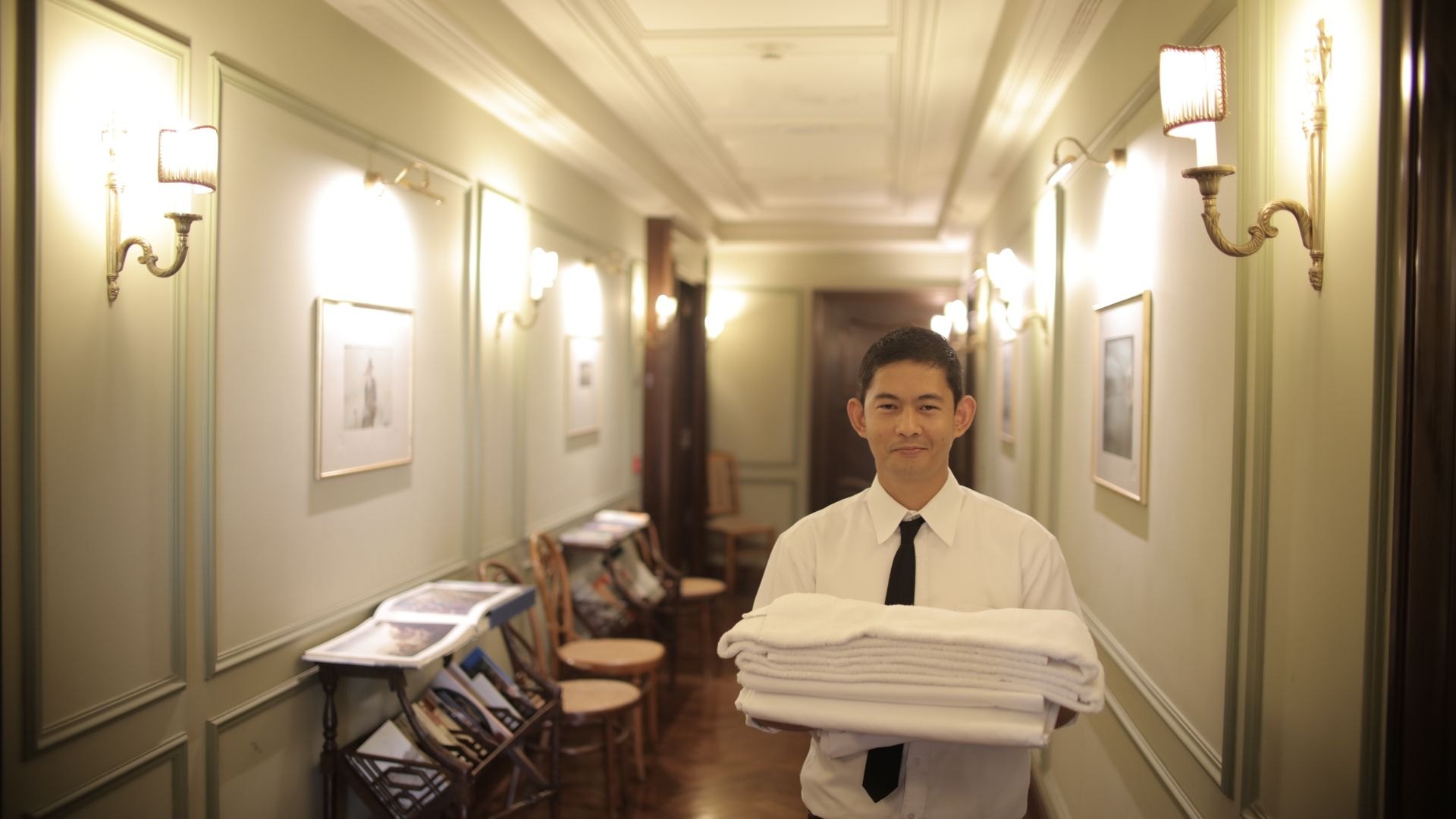
Guests see one side of how a hotel moves people around.
They arrive at reception, take a passenger lift to their room and perhaps use the same lift to reach a restaurant, meeting space or leisure facility. What they rarely see is the movement taking place behind the scenes.
Food leaves kitchens. Used linen comes back from bedrooms. Clean linen has to go in the opposite direction. Housekeeping teams move supplies around the building. Deliveries arrive, waste needs removing and catering equipment may need to travel between different levels.
In a large hotel, that movement continues for much of the day.
Trying to handle all of it through the same lifts used by guests can create obvious operational problems. This is why the vertical transport within a hotel often needs to be considered as two separate requirements: moving people and moving goods.
The Guest Lift Is Only Part of the Building
A hotel passenger lift has a straightforward purpose from the guest’s perspective. It needs to get people between floors safely and without unreasonable delay.
Behind the scenes, the requirements are different.
A kitchen may need ingredients delivered from storage on another level. A restaurant may require prepared dishes to move directly from a kitchen below. Housekeeping staff need access to linen and consumables throughout the building. Function rooms can create sudden demand for catering supplies, furniture and equipment.
Using guest-facing passenger lifts for all of these movements may be possible in some buildings, but it is not necessarily a good operational arrangement.
A housekeeping trolley occupying a passenger lift at 9am is competing with guests leaving their rooms. The same applies when catering equipment needs moving during a busy event or supplies are being taken to another floor.
The issue is not simply appearance. It is about understanding the different traffic moving through the building and providing sensible routes for it.
Not Everything Needs a Full-Sized Lift
One mistake when considering back-of-house movement is assuming that every requirement needs a large goods lift.
Often it doesn’t.
A restaurant with its main kitchen on a different floor from the dining room may only need to move relatively small loads between the two. Plates, prepared food, ingredients, or kitchen items don’t require the same lift space as a loaded housekeeping trolley.
This is where dumbwaiters and trolley lifts serve different purposes.
A dumbwaiter is a compact goods-only lift generally used to move smaller items between levels. In hospitality settings, food service is an obvious application, although the same type of lift can be used for other appropriate goods.
Loading typically occurs at a convenient working height, allowing staff to place items into the lift without entering the car.
A trolley lift deals with a different problem.
When the load is already on wheels, floor-level loading lets staff move a trolley into the lift rather than unloading and transferring its contents individually. Depending on the application, this can be useful for catering trolleys, supplies and other larger wheeled loads.
Calling one a bigger version of the other misses an important point. The way the goods are loaded and handled is part of the specification.
The Load Needs to Be Understood Before the Lift Is Chosen
It is easy to start with lift capacity because it produces a simple number.
In practice, knowing that a lift can carry a particular weight is only part of the information needed.
What is actually being moved? How large is it? Is it carried by hand or transported on a trolley? How frequently will the lift operate? Where does loading need to take place? How many floors need to be served?
A bulky but relatively light item can require more car space than a much heavier compact load.
The loading height matters too. A dumbwaiter designed for hand-loaded items has a very different working arrangement from a trolley lift where the load needs to roll directly into the car.
Frequency of use can also affect the specification. A lift making occasional journeys between two levels has a different duty from one supporting a busy kitchen through breakfast, lunch, functions and evening service.
These questions sound basic, but answering them before selecting equipment prevents the lift from becoming an awkward part of the operation later.
Older Hotels Can Be Particularly Difficult
Hotels operating from older buildings present another problem: there may be no obvious place to put a lift.
Many hotels have evolved rather than being designed in their current form. Bedrooms have been added, restaurants relocated, kitchens extended and service areas adapted over years of refurbishment.
Historic hotels can be more complicated again.
Available floor space may be limited. Existing walls and structural elements restrict possible positions. Headroom or pit depth can be tight. Services may already occupy the most obvious route through the building.
This is where survey work becomes important.
A compact service lift can sometimes be incorporated where a conventional lift would be impractical, but that does not mean it can simply be inserted into any available space. The supporting structure, access at each landing, required openings, fire considerations and interfaces with the surrounding building all need to be understood.
Position is particularly important in a hotel.
A dumbwaiter located too far from the kitchen may technically move food between floors while creating an inefficient route for staff. A trolley lift that opens into the wrong part of a service area can cause similar problems.
The shortest engineering solution is not always the best operational one.
Goods-Only Means Goods-Only
An important distinction should never blur when specifying smaller service lifts.
A dumbwaiter is not a small passenger lift.
Neither should a standard goods-only trolley lift be treated as a means of moving members of staff between floors.
Equipment needs to be used for the purpose for which it has been designed and specified. If people need to travel with a load, that requirement must be identified at the outset so an appropriate lift solution can be considered.
This sounds obvious, but the distinction matters in buildings where staff are under pressure to move things quickly.
The fact that a lift car appears physically large enough for someone to enter does not mean it has been designed, protected or controlled for passenger use.
Good specification removes that ambiguity from the beginning.
Food Movement Brings Its Own Practical Questions
Hotels with restaurants, bars, room service or banqueting facilities have another set of considerations.
A lift carrying food needs to fit into the kitchen’s actual workflow.
If prepared dishes are travelling from a lower-ground-floor kitchen to a restaurant above, staff need a sensible loading point at one end and an equally practical unloading point at the other. Doors, landing heights and car dimensions all affect how comfortably that happens.
Cleaning matters as well.
Surfaces in equipment used around food service need to be suitable for the environment and capable of being kept clean. The lift should not introduce an unnecessary hygiene problem into an otherwise well-managed kitchen.
Then there is the return journey.
Plates, trays and other items do not disappear after reaching the restaurant. Used items need to return, which means the movement pattern has to work in both directions during busy periods.
Looking only at how food gets from the kitchen to the dining room gives half the picture.
Trolleys Change the Requirement Again
A trolley creates different demands because the load is moved as a complete unit.
Floor-level access becomes important. So does the relationship between the car dimensions and the trolley itself.
It is not enough for a trolley to fit through the entrance by a few millimetres on paper. Staff need to be able to approach, load and remove it without an unnecessarily awkward manoeuvre.
The route outside the lift matters for the same reason.
A perfectly specified trolley lift is of limited use if a tight turn immediately outside the landing makes the trolley difficult to position.
Hotels considering a trolley system should therefore look beyond the lift shaft. The journey from storage, kitchen or service area to the lift, and then from the lift to the destination, is part of the same process.
Keeping Back-of-House Traffic Out of Guest Areas
Hotels put considerable thought into the environment guests see.
That can be undermined surprisingly quickly when operational traffic has no alternative but to use the same circulation space.
Clean and used linen, housekeeping trolleys, catering supplies and waste are all normal parts of running a hotel. Guests simply do not need to encounter all of them.
Separate service routes can help reduce that crossover.
That does not mean every hotel needs a dedicated lift for every type of load. Smaller properties may operate perfectly well with shared arrangements. Larger hotels, or buildings with significant food, events and housekeeping operations, may have a much stronger case for separating passenger and goods movement.
The correct arrangement depends on the building and how intensively it operates.
A Small Lift Can Solve a Very Specific Problem
Service lifts are sometimes overlooked because they are less visible than the main passenger lifts.
Their value is often much more practical.
If staff currently carry trays repeatedly between floors, unload trolleys because they cannot be moved directly to another level or wait for a busy passenger lift every time supplies need transporting, there is a clearly identifiable movement problem.
The answer is not automatically a dumbwaiter or trolley lift. Sometimes the building layout or operating procedure can be changed instead.
Where a lift is appropriate, however, its purpose should be equally clear.
The most successful installations tend not to be the ones with the greatest capacity or most elaborate specification. They are the ones that deal with a movement that happens repeatedly during the working day and place the lift where staff actually need it.
For a hotel guest, that equipment may remain completely unnoticed.
For the people keeping the hotel running, that is rather the point.
