


A Beijing programmer was laid off alongside about 160 colleagues after his boss asked whether AI could replace coders, a question that proved its own answer within two weeks, in a pattern playing out across China’s labour market as China AI job losses accelerate.
Fei Zhaojun, 40, had doubted AI could do programming work perfectly. His bosses thought it was close enough. ‘Mid-level coders’ jobs are essentially replaceable in most of the cases,’ said Fei, who is now making vlog-style short videos during a career break. ‘Even if it is a disaster that leads to replacing all humans, at this stage, you just have to use it as everyone else is using it.’
Government targets driving China AI job losses across sectors
Beijing is not a passive observer. Under the ‘AI Plus’ initiative and a five-year plan running to 2030, the government is pushing AI into industries from logistics to education. According to the South China Morning Post, China has set targets for AI-powered device adoption of over 70% across major industries by 2027, rising to over 90% by 2030.
The strategy mirrors an earlier playbook. The ‘AI Plus’ drive followed the 2015 ‘Internet Plus’ initiative, which helped transform China into a highly digitised society, the South China Morning Post reported. AI is now the next lever.
The share of Chinese industrial enterprises reporting use of AI models and agents jumped to 47.5% last year from 9.6% in 2024, according to market intelligence firm IDC. ‘China’s vibrant open-source model ecosystem fosters greater AI application innovation in industrial settings,’ said Yanze Du, a senior research manager at IDC in Beijing.
‘What is specific to China is that the government is really into diffusing AI across the economy, so AI may get into different domains more quickly comparing to other countries,’ said Zilan Qian, a research associate at Oxford China Policy Lab.
Translators, scriptwriters and delivery workers feel the pressure
Du Qinchun, a part-time translator based in Chengdu, has been helping to train an AI model to do translations, work that has brought him more assignments, at least for now. ‘But it’s true that the pay in the industry has been cut by more than half compared to what it was years ago,’ he said. Popular college programmes in foreign languages have fallen out of favour as AI translation tools spread.
In short-form video and drama, the disruption is equally blunt. The number of live-action short and vertical video series designed for mobile phones fell about 75% in the first quarter of this year from a year earlier, according to Chinese media reports. Scriptwriter Wang Zhicheng, 32, resigned after his employer laid off roughly half of its 13 writers and now makes illustrated children’s books independently. ‘You can treat AI as a tool just like Word,’ he said. ‘Humans are still the decision makers on which one to pick or pursue among all that AI generates.’
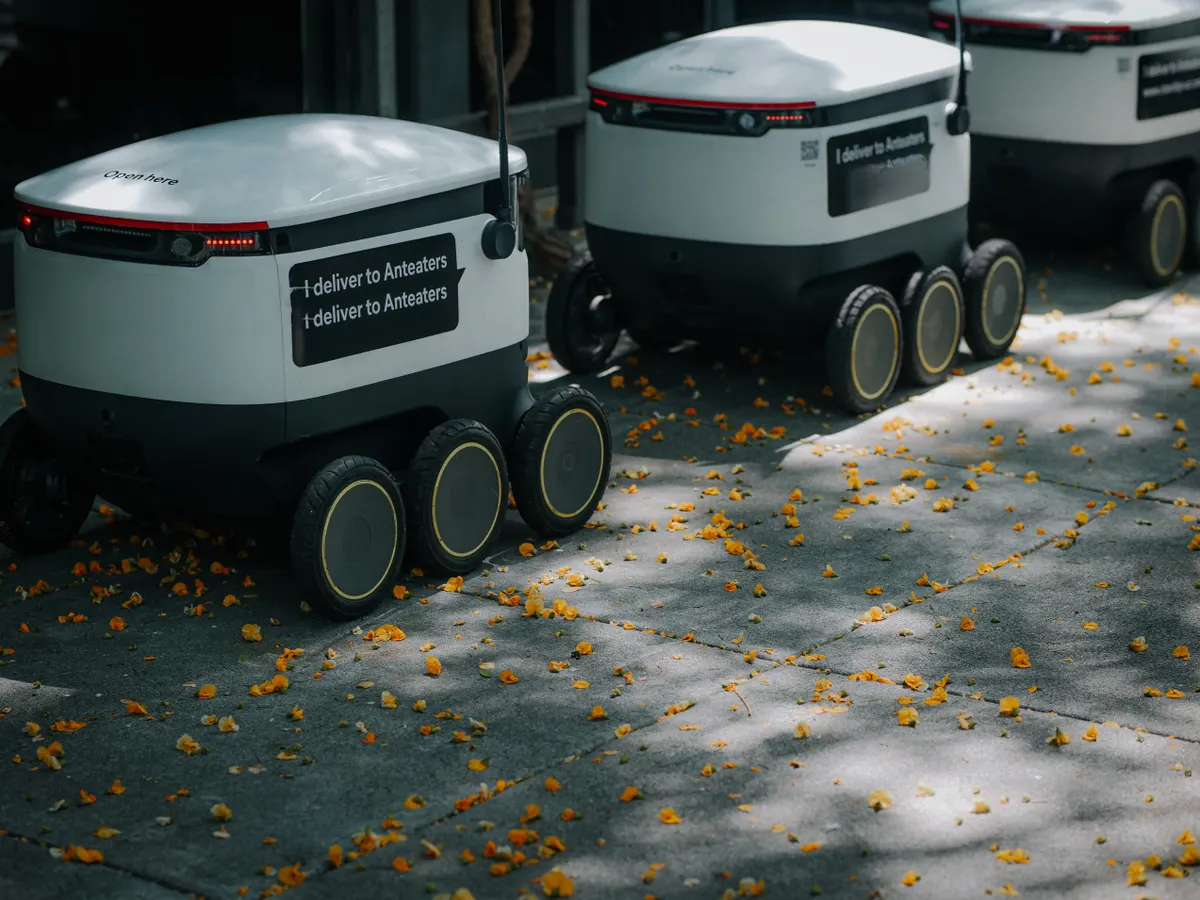
Food delivery robots are gaining ground across the country, potentially threatening livelihoods of millions of delivery workers. Humanoid robots can sort parcels in postal centres, though still on a small-scale basis.
An International Labour Organization report found that women face higher risks of job displacement from AI than men, as they tend to work in areas more suitable for automation, such as assembling electronics, and remain underrepresented in science and technology.
China’s overall urban unemployment rate hovers around 5%. For people aged 16 to 24, excluding students, the rate is roughly triple that. ‘AI is likely to lift productivity across the board but could have a severe disruptive effect on employment, worsening the employment growth problem and resulting in a detrimental effect on social stability,’ said Eswar Prasad, a professor of economics and trade policy at Cornell University.
Over a longer horizon, some researchers point to demographics as a counter-weight. By 2050, China is projected to have fewer than two working-age adults supporting each retiree, said Xuenan Cao, a professor at San Francisco Bay University. ‘Automation could partially offset a shrinking workforce rather than being purely a threat to it,’ Cao said. The government’s 90% adoption target for 2030 means the pace of that offset is set to be tested well before then.
