


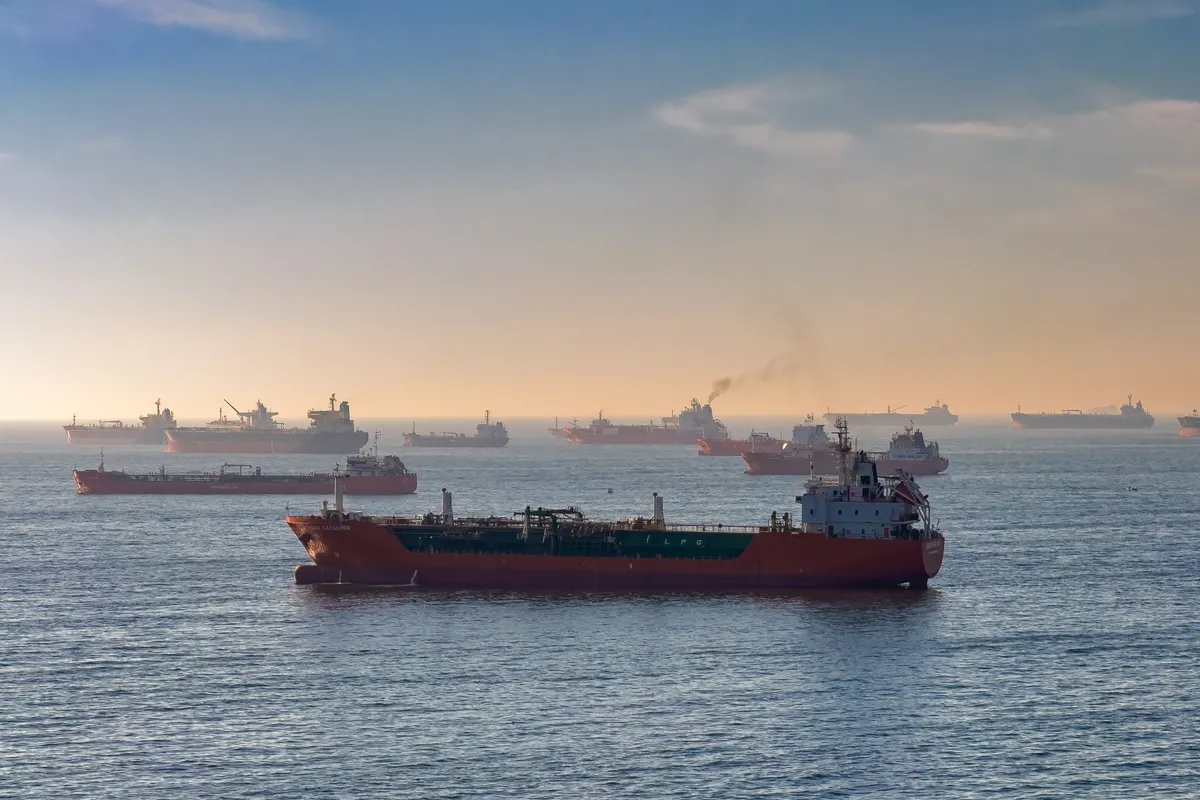
The Iran war oil crisis has driven crude oil above $101 per barrel and pushed U.S. diesel to a record $200 per barrel, only the second time that threshold has been breached, as choking flows through the Strait of Hormuz threaten fuel shortages across the UK, Europe and South Asia.
The global benchmark for crude topped $101 on Wednesday for the first time since July. Diesel’s crossing of $200 per barrel has happened just once before, briefly in 2022 after Russia’s invasion of Ukraine.
The U.S. Energy Information Administration (EIA) recorded an average of 20 million barrels per day flowing through the Strait of Hormuz in 2024. Between 2022 and 2024, crude oil and condensate volumes through the strait fell by 1.6 million barrels per day, and analysts say the current escalation has pushed flows far lower still.
Iran war oil crisis tightens grip on global fuel stocks
‘The conflict has entered a new stage,’ said Susan Bell, senior vice president at Rystad Energy. ‘Global stocks of diesel, gasoline, and jet fuel have drawn down an awful lot; they are now at critical low levels. They’ve breached levels we last saw after Russia first invaded Ukraine.’
Bell said prices must rise further to force ‘demand destruction’. ‘I hate to say it, but we need prices at the pump to go up higher to encourage consumers to make choices on their energy consumption. We need more (global) austerity measures,’ she told Fortune.
She added that heading into the autumn and winter, fuel shortages, especially diesel, will become more prevalent in the UK and other parts of Europe, as well as much of South Asia.
This week the U.S. has more aggressively attacked Iranian oil tankers, with Iran targeting vessels in return. Yemeni Houthi forces have also escalated attacks on Saudi Arabian energy facilities and vessels in the Red Sea, striking tankers that were already diverting away from Hormuz. As a result, moderate tanker traffic through the strait, sometimes above 50% of pre-war volumes in recent weeks, has slowed to very little movement.
Diesel the ‘bigger canary in the coal mine’
Oil forecaster Dan Pickering, founder of Pickering Energy Partners, said the market is competing for a dwindling diesel supply with no quick fix available.
‘The [global] market is competing for a limited supply of diesel. So, at what point do we worry? We worry now,’ Pickering told Fortune. ‘Prices are quite high and there’s no easy relief valve. Nobody is building new oil refineries.’
‘There’s a growing awareness that diesel is the bigger canary in the coal mine right now. Folks are paying attention to $100 [oil], but they really ought to be paying attention to $200 diesel,’ he added.
Pickering also warned of the wider inflationary fallout. ‘The risk that this shows up in inflation is growing, not just U.S. inflation, but global inflation,’ he said, noting that central banks may face renewed pressure to raise interest rates.
The average price for a gallon of regular unleaded gasoline in the U.S. reached $4.22 on Wednesday, an all-time September high. U.S. pump prices for diesel are already at their highest ever.
Casey’s General Stores chief executive Darren Rebelez said on an earnings call Wednesday that customers are buying fewer gallons per trip, shifting away from premium fuel grades, and cutting back on in-store snacks. The behavioural shift is starker among lower-income customers, he said.
The U.S. Strategic Petroleum Reserve is at a 44-year low, and there are no comparable strategic reserves for refined fuels, with refineries offline from the Middle East to Russia.
Rystad Energy chief economist Claudio Galimberti said depleting inventories and demand destruction may keep the global economy afloat into November and early December. By the end of the year, a U.S.-Iran truce may become necessary to avoid major economic damage into 2027, he said. ‘The [Trump] administration will want to show inflation is under control.’
President Donald Trump said on Wednesday he expected Iran to continue the war through the November midterm elections to damage him politically, and said he would aim to end the war ‘immediately after the election.’
